

Wondercraft is becoming the AI video studio for real work.
When we started Wondercraft, we thought we were building an audio company.
We wanted to help anyone turn text into sound: podcasts, ads, meditations, narrations. If you could write it, you could make it sound good. And it worked. People all over the world used Wondercraft to tell stories, train teams, and ship content faster.
But over time, something became obvious. The internet doesn’t really run on audio. The internet runs on video.
And over the last year, something else became obvious too: AI video crossed a quality threshold.
Suddenly, with new models coming out every few months, generating video is no longer the hard part. But using it… is.
The strange moment AI video is in
If you follow AI, it probably feels like video just exploded. Sora. Veo. A dozen other models. Every week, a new demo that looks impossible.
And yet, when we talk to real teams, marketing, L&D, HR, comms, we hear the same thing:
“We can generate cool stuff. We can’t ship it.”
They have clips.
They have experiments.
They have folders full of “AI tests”.
What they do not have is a reliable way to produce real videos for training, onboarding, internal updates, product launches, or social content.
Video generation is no longer the bottleneck. Making it usable is.
The clip problem
Most AI video tools today are built around a simple idea: prompt → clip. And that’s impressive. But that’s not how work happens.
Real video needs to be on brand, editable, reviewable, and repeatable across a team. A cool clip is not a workflow. A cool clip is not a system. A cool clip is not production.
Most AI video tools generate clips. Businesses need outcomes.
We’ve seen this pattern before
First, new technology is magical. Then it’s chaotic. Then someone turns it into a system.
That’s what happened with design tools, developer tools, and collaboration tools. AI video is entering that phase now.
Avatars were the first wave. They proved companies were ready to use AI video. But now that visuals can be so much richer, the real challenge is no longer “can we generate this?”
It’s: can we actually use this, every week, with real teams, for real work?
What we decided to build
About a year ago, we made a big internal decision. We didn’t want to build another AI toy. We wanted to build the AI video studio teams actually rely on.
That meant a few things:
- Stop thinking in prompts
- Start thinking in outcomes
- Stop exposing raw tools
- Start building workflows
Training video is not the same as a product launch. An internal update is not the same as a social ad. A highlight reel is not the same as a narrated explainer.
Each of these has a structure. A logic. A set of decisions that matter.
So we built Wondercraft around that.
Meet the new Wondercraft
Today, Wondercraft is an AI video studio that brings together:
- The best AI models across video, images, voice, music, sound, and text
- A real editor for control, timing, and branding
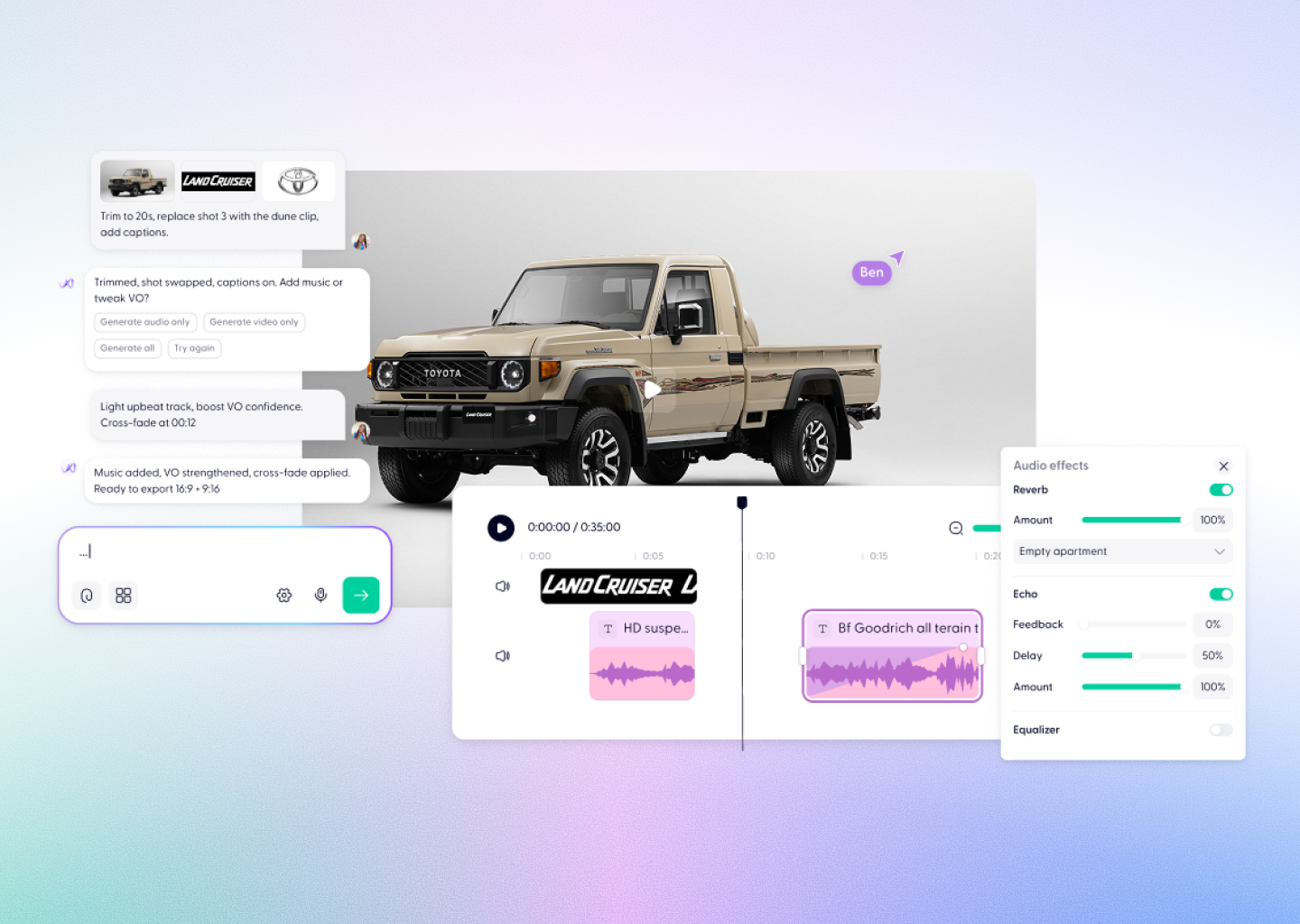
- And Wonda, our AI agent that orchestrates everything
Instead of starting from a blank timeline or a blank prompt, you start from what you want to make:
- Explain and educate (training, onboarding, internal updates, docs to video)
- Promote and launch (product launches, announcements, ads, social videos)
- Polish existing content (cutdowns, localisation, highlight reels, cleanup)
You make a few decisions. Wondercraft generates a strong first draft. And then you refine. Wonda doesn’t replace editing. It makes creation productive.
The three layers
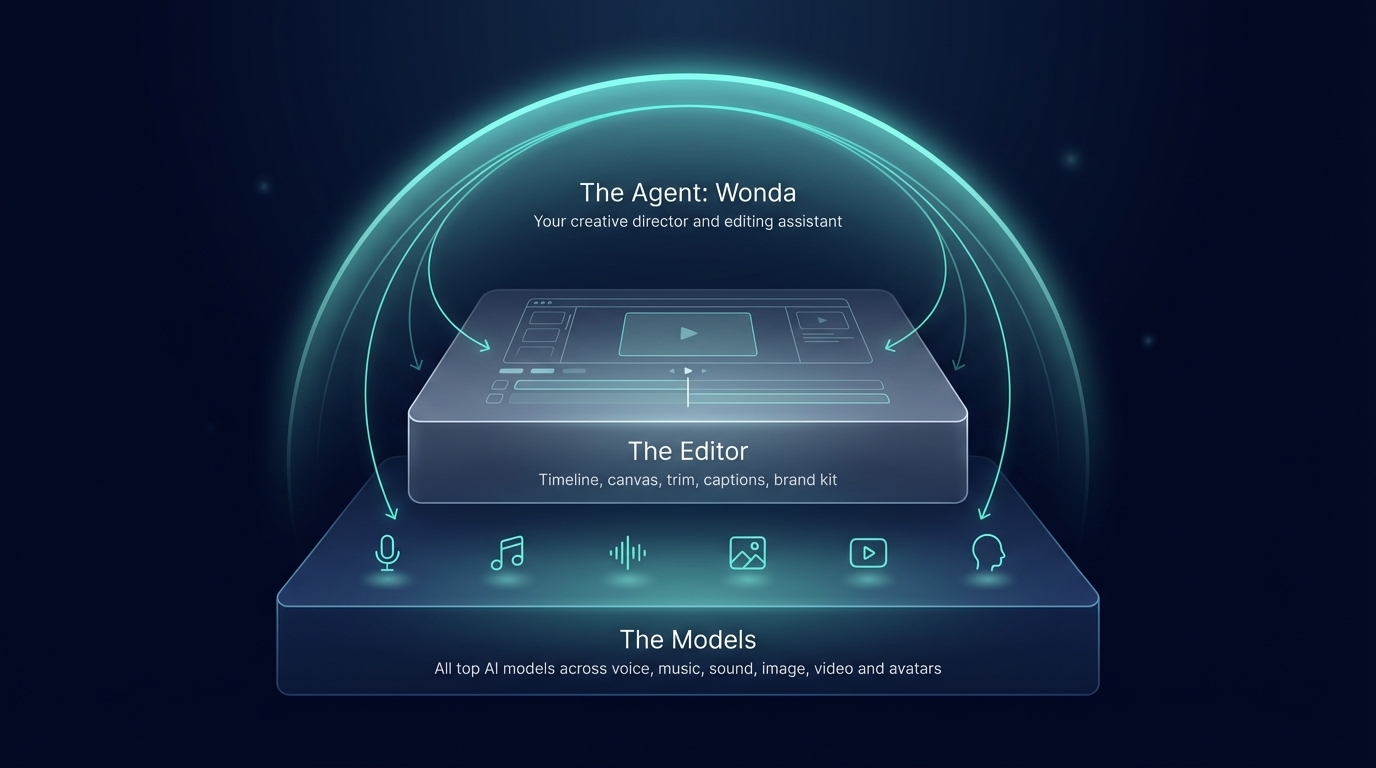
Under the hood, Wondercraft is built on three layers:
- The Models
- The Studio
- Workflows (powered by Wonda)
Outcome-driven flows that encode best practices and generate strong first drafts.
A real editor for when details, timing, and branding matter.
Best-in-class AI across video, images, voice, music, sound, and text — orchestrated behind the scenes, not dumped on the user. The goal isn’t to show you more AI. The goal is to help you ship more video.
Who this is for
We are building Wondercraft primarily for marketing, communications, enablement, HR, and L&D teams.
Teams that need to produce video regularly, quickly, and on brand, without turning video into a specialised skill.
We also see agencies and AI-native creators using Wondercraft as a powerful studio.
But the core mission is simple: If the content has a job to do inside a business, Wondercraft should be able to make it.
Where this goes
AI models will keep changing. That’s a given. There will be better video models, better voice models, better everything. What matters more is what people can actually do with them.
We don’t think the long-term winners in this space will just be the companies building models. They’ll be the companies teams trust to turn all of this into something usable inside real workflows. That’s the layer we’re trying to build with Wondercraft.
AI video is already powerful. But without structure, it mostly creates noise. Our job is to turn that power into something teams can rely on.
Starting today, Wondercraft is fully an AI video studio. You can start from footage, from a script, from a document, or from just an idea, and turn it into something you can actually ship.
For us, this feels less like a pivot and more like the product finally becoming what it was always trying to be.
We’re excited to see what you build with it.